

8 Min. Read

02 Dec 25
Top 10 Quantum Cybersecurity Jobs Hiring Now in USA
Discover quantum computing jobs in cybersecurity across the USA. Learn about salaries, skills needed, and how to break into quantum cybersecurity careers.
SHARE


Introduction
Quantum computing is changing many parts of our lives, including cybersecurity. This progress brings both new threats and opportunities. One major concern is how it could affect current encryption methods, putting our security at risk. Understanding the new concepts being introduced is highly desired, particularly those that intertwine cybersecurity with quantum theory.
There is a high demand for security systems that can handle quantum technology. This need comes from important groups like governments, tech companies, and financial institutions. The interest in available security systems, especially those in healthcare, logistics, finance, and cybersecurity is geared towards recruiting new and qualified candidates. The demand for workers in the mentioned fields is projected to grown exponentially in the near future.
This article serves as a guide to the best quantum cybersecurity careers in the United States. It also looks at future career possibilities in this field, starting from the basics of quantum cyber security. Is quantum cyber security a flat and rewarding life career for you? This article will help you choose the skills needed for the ten best careers, along with their salaries, educational paths and how to access these in-demand jobs.
Most businesses remain dangerously unprepared for Q-Day. John Young, Chief Operating Officer at Quantum eMotion America
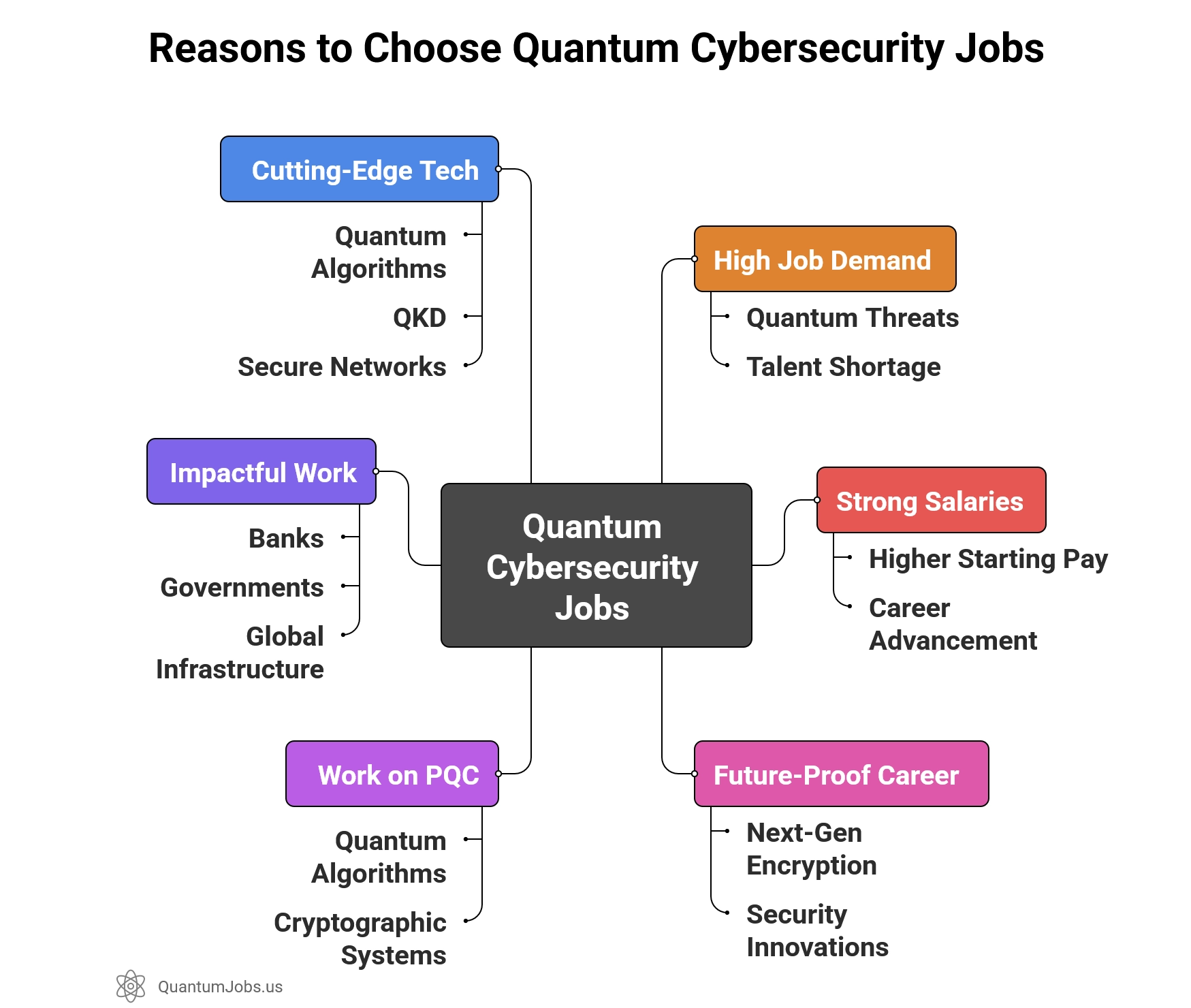
What is Quantum Cybersecurity?
Understanding Quantum Computing in Security
Quantum cybersecurity is the combination of quantum computing and information security. In contrast to classical computers, which operate using binary bits, quantum computers solve specific problems more quickly than classical systems because they take advantage of superposition, entanglement, and other quantum phenomena.
The speed advantage of quantum computers poses security risks. Your bank account details and government secrets are safe because they are protected by encryption. This encryption relies on math problems that regular computers would take thousands of years to solve. In contrast, quantum computers can solve those problems in a matter of minutes, rendering current security systems ineffective.
The threat of having quantum computers that can execute powerful calculations has given rise to the concept of "Q-Day," the term used to refer to the day quantum computers can effectively breach encryption algorithms like RSA and ECC. Experts predict that Q-Day is likely to be in the next ten years, which is why quantum cybersecurity becomes critical for professionals in the technology field.
The Intersection of Quantum and Cybersecurity
There are several elements of quantum cybersecurity that you should know about.
The first is the area of post-quantum cryptography, which focuses on creating methods of encryption that are secure against attacks from both classical and quantum computers. Organizations such as NIST are working to streamline these quantum-resistant algorithms and make them available to the public.
Another is quantum key distribution, or QKD, which applies the principles of quantum mechanics to establish theoretically unbreakable communication channels. Anyone attempting to eavesdrop on a quantum-encrypted message will alter the quantum state and thus both parties will know that the message has been compromised.
The real-world applications of these technologies are already visible across various sectors. Financial institutions are employing quantum-safe encryption to secure the protection of their transactions. Healthcare institutions are shielding their patients’ data from potential quantum breaches. Government bodies are upgrading the encryption on their confidential communication to quantum-resistant systems.
Why Quantum Cybersecurity Jobs are Growing in the USA?
Market Demand and Growth Statistics
The quantum workforce is still new, but it is expected to reach about $13 billion and grow by 25% each year in the US alone. This growth will likely create thousands of new jobs by 2027. This is driven by the confluence of technological opportunity, national security and governance/supervisory issues in the domain.
The US National Quantum Initiative has made quantum technology a national priority, and the country has already allocated billions to quantum research, development and training. Sponsoring quantum development has also become a priority in the private sector, and both new and established technology companies have very ambitious goals vis-a-vis quantum supremacy and its subsequent commercialization.
The urgency is apparent. Adversaries are already doing what is called 'harvest now, decrypt later', which involves collecting encrypted information and storing it to be decrypted later when quantum computers become available. This means organizations are required to put quantum-safe security in place now more than ever before in order to safeguard information that is sensitive, and hence, has to be kept confidential for long periods (years or even decades).
In Couple of years, enterprises will start deploying post-quantum cryptography at scale ... moving out of the 'discovery' phase at the start of their adoption roadmaps. Ben Packman, Chief Security Officer at PQShield
Key Industries Hiring
The quantum cybersecurity job market mainly involves government agencies and defense contractors. This focus reflects the needs for national security and defense in today's geopolitical landscape. The NSA, NIST, and Department of Defense are hiring quantum security professionals to shield their sensitive data and safeguard essential assets.
Financial Services companies understand that their business models, which revolve around confidential data, will be profoundly disrupted by quantum computing. As a result, large banks, investment firms, and insurance companies are actively constructing teams focused on quantum security to ensure their systems are resilient and maintain their clients’ trust.
Healthcare and pharmaceutical companies must secure sensitive patient data and the associated intellectual property for long time frames. As a result, they are spending considerable resources on quantum security to meet compliance obligations and protect themselves from future breaches.
Tech companies that are developing quantum computers also require their own cybersecurity professionals who are well-versed in the security challenges of their systems. Consulting companies are broadening the scope of their quantum practices in order to assist clients in various sectors who are preparing for the quantum world.
What are top 10 Quantum Jobs in Cybersecurity in USA?
1. Quantum Cryptography Engineer
What They Do:
- Design quantum-safe encryption
- Build quantum key distribution systems
- Plan the shift to quantum-safe security.
- They test algorithms against quantum threats;
- Add quantum-safe tools to existing systems.
- Work with hardware teams on secure links.
- Follow industry rules & standards;
- Check current encryption for weak points.
Required Skills:
- Strong skills in number theory, linear algebra and discrete math.
- Strong knowledge of classical cryptographic systems and protocols.
- Clear understanding of quantum states & entanglement.
- Ability to program in Python, C++ and Q#.
Average Salary: Quantum cryptography positions earn between $88000 and $145000 a year. Experienced professionals at major tech companies and defense contractors commanding salaries toward the higher end of this range.
Top Employers: IBM, Google, Microsoft, Lockheed Martin, NSA and major financial institutions actively recruit quantum cryptography engineers.
Education: Most positions require a master degree or PhD in computer science, physics, mathematics or cryptography. Though exceptional candidates with bachelor degrees and relevant experience may be considered.
2. Post-Quantum Security Analyst
What They Do:
- Find quantum risks in current encryption.
- Train teams on quantum threat basics.
- Audit systems for weak points;
- Build plans for NIST post-quantum standards.
- Check vendor tools for quantum-readiness.
Required Skills:
- Knowledge of NIST and ISO 27001 frameworks.
- Ability to explain complex ideas in simple terms.
- Skill in risk assessment methods;
- Clear understanding of NIST post quantum standards.
- Strong grasp of network security basics.
Average Salary: Entry-level positions start around $75000 - $95000. Experienced analysts earn $120000 - $150000 a year.
Top Employers: Deloitte, Accenture, PwC, Booz Allen Hamilton, major banks, and large enterprises seeking quantum transition expertise.
Education: Bachelor degree in cybersecurity, information technology, or related field required. Professional certifications like CISSP, CISM, or Security+ significantly enhance prospects.
3. Quantum Algorithm Developer
What They Do:
- Create quantum algorithms for security tasks.
- Work with hardware teams to match platform limits.
- Optimize quantum circuits for better performance;
- Explore quantum machine learning for threat detection.
- Turn quantum theory into working code.
Required Skills:
- Skill in Qiskit, Cirq and Q#.
- Strong algorithm design background.
- Understanding of complexity theory & optimization.
- Knowledge of machine learning basics.
- Strong grasp of linear algebra and quantum information.
Average Salary: Quantum algorithm developers typically earn $80000 - $140000. Senior developers at leading tech companies earning significantly more.
Top Employers: Microsoft Quantum, Amazon AWS, Google Quantum AI, IonQ, Rigetti Computing and research institutions.
Education: PhD strongly preferred in computer science, physics or applied mathematics. Exceptional master graduates with strong publication records may be considered.
4. Quantum Network Security Specialist
What They Do:
- Build and manage quantum communication networks.
- Work with telecom teams to deploy quantum links.
- Set up quantum key distribution & repeaters;
- Add quantum security to classical networks.
- Monitor network performance and fix issues.
Required Skills:
- Understand network architecture and protocols.
- You must know QKD protocols and security procedures.
- Know quantum communication principles;
- Familiarity with fiber optics & telecom systems.
- Experience with quantum networking hardware.
Average Salary: Network security specialists focusing on quantum systems earn approximately $85000 - $145000 depending on experience and location. You can learn more about Quantum Jobs Salaries here.
Top Employers: AT&T, Verizon, defense contractors, national laboratories and quantum communication startups.
Education: Bachelor's or master degree in network engineering, computer science, physics or electrical engineering required.
5. Quantum Security Researcher
What They Do:
- Research quantum cryptography and security threats.
- Present findings at conferences.
- Develop new quantum-resistant protocols.
- Work with government & academic teams;
- Supervise students and write research grants.
Required Skills:
- Strong research and experimental design skills.
- Experience with grants & peer review.
- Deep knowledge of quantum information theory.
- Solid mathematical foundation.
- Skilled in academic writing.
Average Salary: Research positions in quantum computing average around $131000 a year. Senior researchers at prestigious institutions earning considerably more.
Top Employers: MIT, Stanford, Caltech, national laboratories (Los Alamos, Oak Ridge, Sandia), DARPA and major research universities.
Education: PhD required in physics, computer science, mathematics, or related field. Postdoctoral experience often preferred for senior positions.
6. Quantum Security Consultant
What They Do:
- Advise on quantum security readiness.
- Translate quantum concepts into business terms.
- Create roadmaps for quantum transitions;
- Give executive briefings on quantum threats.
- Design training & workshops for teams.
Required Skills:
- Strong consulting and client management skills.
- Experience working with C-level executives.
- Knowledge of quantum computing & cryptography;
- Excellent communication & presentation abilities.
- Project management and business skills.
Average Salary: Consultants typically earn $115000 - $185000 a year, with performance bonuses potentially adding $10000 - $30000.
Top Employers: McKinsey, Boston Consulting Group, PwC, EY, Deloitte and specialized quantum consultancies.
Education: Master degree in relevant technical field required; MBA or advanced business degree advantageous for client-facing roles.
7. Quantum Software Security Engineer
What They Do:
- Build software resistant to quantum attacks.
- Manage full software development lifecycle;
- Integrate post-quantum cryptography libraries.
- Test software against quantum attack simulations.
- Conduct secure code reviews.
Required Skills:
- Skilled in Python, Java, C++ and JavaScript.
- Familiarity with quantum programming frameworks;
- Understand secure software development practices.
- Experience with cryptographic libraries.
- Knowledge of DevSecOps methods.
Average Salary: Quantum software engineers typically earn $78000 - $135000. Senior engineers at major tech companies earning up to $190000.
Top Employers: Apple, Meta, Google, Amazon, JPMorgan Chase, Microsoft and government agencies.
Education: Bachelor's or master's degree in computer science, software engineering, or related field required.
Suggested Read: Top Online Courses for Quantum Jobs
8. Quantum Threat Intelligence Analyst
What They Do:
- Monitor global quantum computing developments.
- They collaborate with cyber threat teams.
- Track quantum capabilities of adversaries;
- Analyze emerging quantum attack vectors.
- Produce intelligence reports for leadership.
Required Skills:
- Know threat intelligence frameworks and methods.
- Translate technical info into actionable insights.
- You must be aware of global quantum investments;
- Strong data analysis skills.
- Skilled in intelligence reporting tools.
Average Salary: Positions range from $90000 for entry-level analysts to $145000 for senior intelligence analysts with security clearances.
Top Employers: NSA, CIA, FBI, Department of Defense, cybersecurity firms, defense contractors and financial institutions.
Education: Bachelor degree in cybersecurity, intelligence studies, international relations or related field required. Security clearance often necessary.
9. Quantum Hardware Security Engineer
What They Do:
- Protect quantum hardware from attacks and interference.
- Ensure secure manufacturing & supply chains.
- Develop quantum random number generators.
- Design physically unclonable functions.
- Test hardware for vulnerabilities and error correction.
Required Skills:
- Strong hardware security knowledge.
- Awareness of side-channel attacks & defenses.
- Understand hardware security modules;
- Solid electrical engineering fundamentals.
- Knowledge of quantum hardware architectures.
Average Salary: Positions typically range from $120000 to $180000. Senior roles at leading quantum computing companies exceeding $200000 a year.
Top Employers: IBM Quantum, Google Quantum AI, Intel, Honeywell Quantum Solutions, IonQ and defense contractors.
Education: Master or PhD in electrical engineering, physics or computer engineering required.
10. Quantum Compliance and Policy Specialist
What They Do:
- Ensure compliance with quantum security regulations.
- Conduct audits & prepare documentation.
- Develop organizational quantum security policies.
- Liaise with regulators like NIST & CISA.
- Train staff on quantum security policies.
Required Skills:
- Knowledge of cybersecurity & data protection regulations.
- Strong writing and documentation skills.
- Understand NIST post-quantum standards.
- Skilled in risk management frameworks.
- Experience in policy development.
Average Salary: Positions range from $100000 to $160000. Senior policy directors earning more at major financial institutions and government agencies.
Top Employers: Government regulatory agencies, financial institutions, healthcare organizations, large enterprises and consulting firms.
Education: Bachelor's degree in relevant field required; law degree, policy degree or compliance certifications (CRISC, CGRC) highly beneficial.
Suggested Read: Top Programming Languages for Quantum Jobs
What are the Skills Required for Quantum Cybersecurity Jobs?
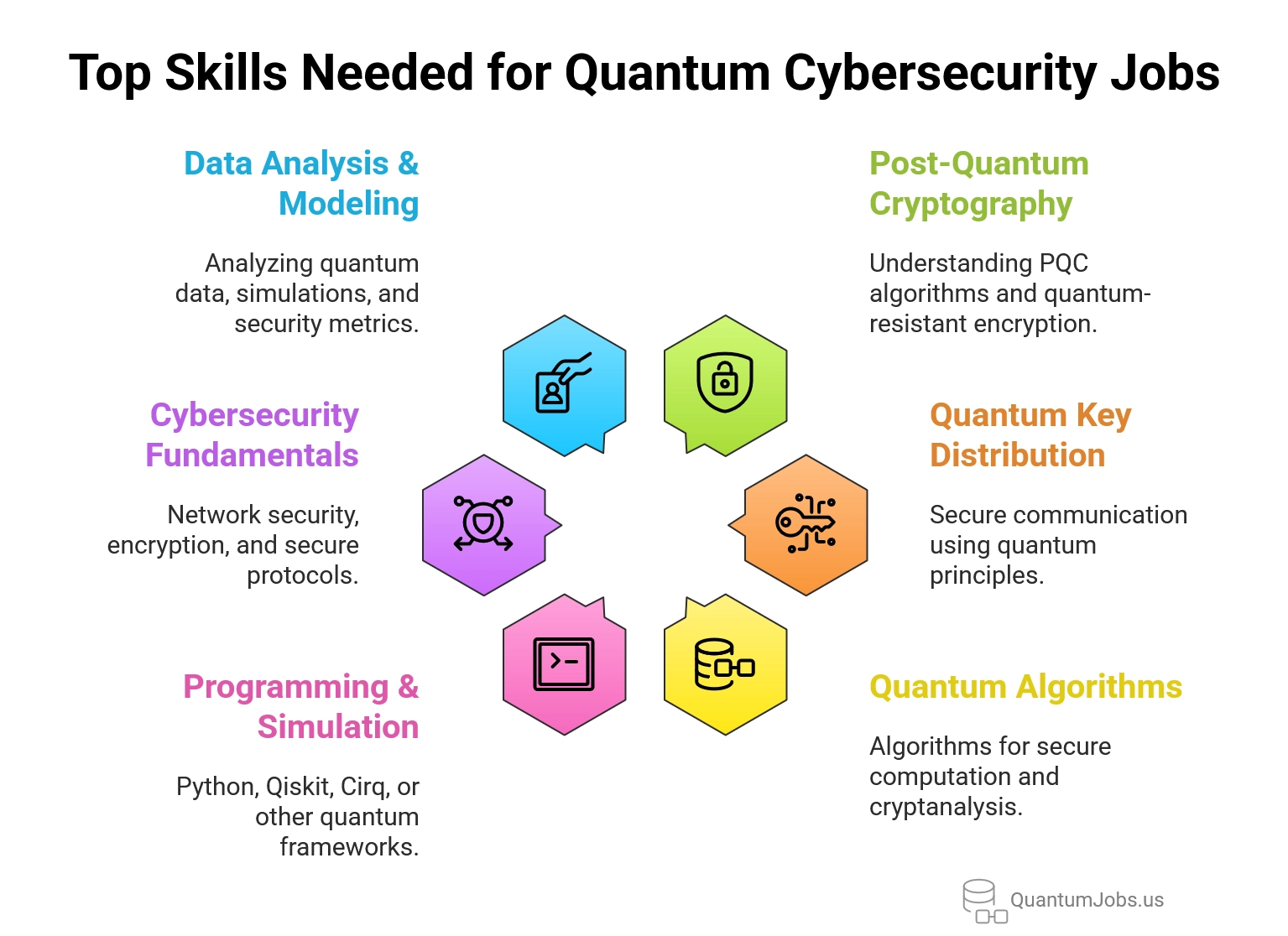
To break into quantum cybersecurity, a candidate needs a specific set of skills including problem-solving abilities, technical skills and a passion for lifelong learning. Let’s discuss each of these skills in turn.
Technical Skills
- Strong math skills: linear algebra, probability, discrete math, and number theory.
- Knowledge of network security, encryption protocols & security frameworks.
- Solid understanding of quantum mechanics: superposition, entanglement, quantum gates, and measurement;
- Programming proficiency: Python, C++ and quantum languages like Q#.
- Familiarity with classical cryptography and libraries.
Soft Skills
No field changes as quickly as quantum. With this in mind, a commitment to continuous learning is key to success. Because quantum is changing so rapidly, whatever you know and learn today may be obsolete in six months. For someone to be in that field for a long time, they have to be intellectually curious and adaptable.
Quantum cybersecurity is a complex and unresolved area. It will always need critical thinking and problem-solving skills. These skills are essential for anyone wanting to make progress in this field.
Communication skills are very important in quantum since it covers many different fields. Working on quantum projects, you will be collaborating with teams of physicists, engineers, and mathematicians, and you will need to communicate seamlessly with business people as well.
Certifications to Consider
Quantum certifications are still being developed, but traditional cybersecurity credentials are still important. The Certified Information Systems Security Professional (CISSP) demonstrates a strong understanding of security. Certified Ethical Hacker (CEH) and GIAC Security certifications prove practical skills in security testing and implementation.
Employers increasingly recognize certifications in quantum computing from IBM Quantum, Microsoft and Google. These show hands-on experience with quantum platforms and frameworks. CompTIA Security+ provides a solid foundation for entry-level positions.
How to Break Into Quantum Cybersecurity Careers?
Entering the field of quantum cybersecurity may feel overwhelming, but with careful planning and commitment. You can succeed no matter your current experience.
Educational Pathways
- Undergraduate degrees in physics, computer science, math or cybersecurity provide foundational knowledge.
- Research internships at labs and tech companies, provide practical experience and networking;
- Graduate programs in quantum information or computing offer specialized paths.
- Online platforms like Coursera, edX & MIT OpenCourseware provide accessible quantum courses.
- IBM Quantum Learning and Microsoft Learn offer hands-on quantum training.
Building Your Skill Set
- Study courses and get certifications to create a solid classical cybersecurity foundation.
- Utilize free tools such as IBM Quantum Experience to get a grasp of the fundamentals of quantum computing.
- Use Qiskit, Cirq, and the Microsoft Quantum Development Kit for practicing.
- To gain and showcase experience, you can get involved in open-source quantum computing initiatives.
- For networking and educational purposes, you can go to workshops and conferences about quantum computing.
Networking and Professional Development
To remain in touch with the industry, you can join quantum computing communities. Places such as the IEEE Quantum Computing Committee, Quantum Economic Development Consortium (QED-C), and Quantum Computing Stack Exchange serve as networking and educational platforms.
For networking, industry conferences are a goldmine. Engage with audience participation, talk to speakers after their talks, and check out student pricing/virtual/cheaper attendance options as they are often available.
Use of LinkedIn is particularly advisable when networking in rapidly growing domains such as quantum computing. Engage with, follow, and join the LinkedIn circles of quantum cybersecurity influencers. Reach out for informational interviews; they are often happy to explain their work in this rapidly evolving domain.
Quantum hackathons allow you to get experience and network in a short amount of time. IBM, Microsoft, and a few universities sponsor these hackathons where you meet and collaborate with other novices to tackle real-world problems and maybe even impress a recruiter.
What are Entry-Level Quantum Cybersecurity Jobs?
Internships in tech companies and national labs are great points of entry. Quantum interns are recruited at companies like IBM, Google, Microsoft, Amazon, and national labs such as Los Alamos, Sandia, Oak Ridge. These internships are a gateway to a full-time position.
Practical experience can be obtained in Junior cybersecurity analyst positions at companies migrating to quantum-safe systems. While you may not be working solely on quantum projects to begin with, you will gain valuable security experience to go along with your quantum knowledge.
Roles of Research Assistant at universities allow you to work on quantum projects while you continue your graduate studies. These positions come with mentorship, publication, and access to state-of-the-art research.
Government fellowships such as AAAS Science & Technology Policy Fellowships, and programs at the Department of Energy place early-career professionals where they can shape and implement quantum policy and are positioned to make a difference.
Suggested Read: Top Entry Level Jobs without Experience
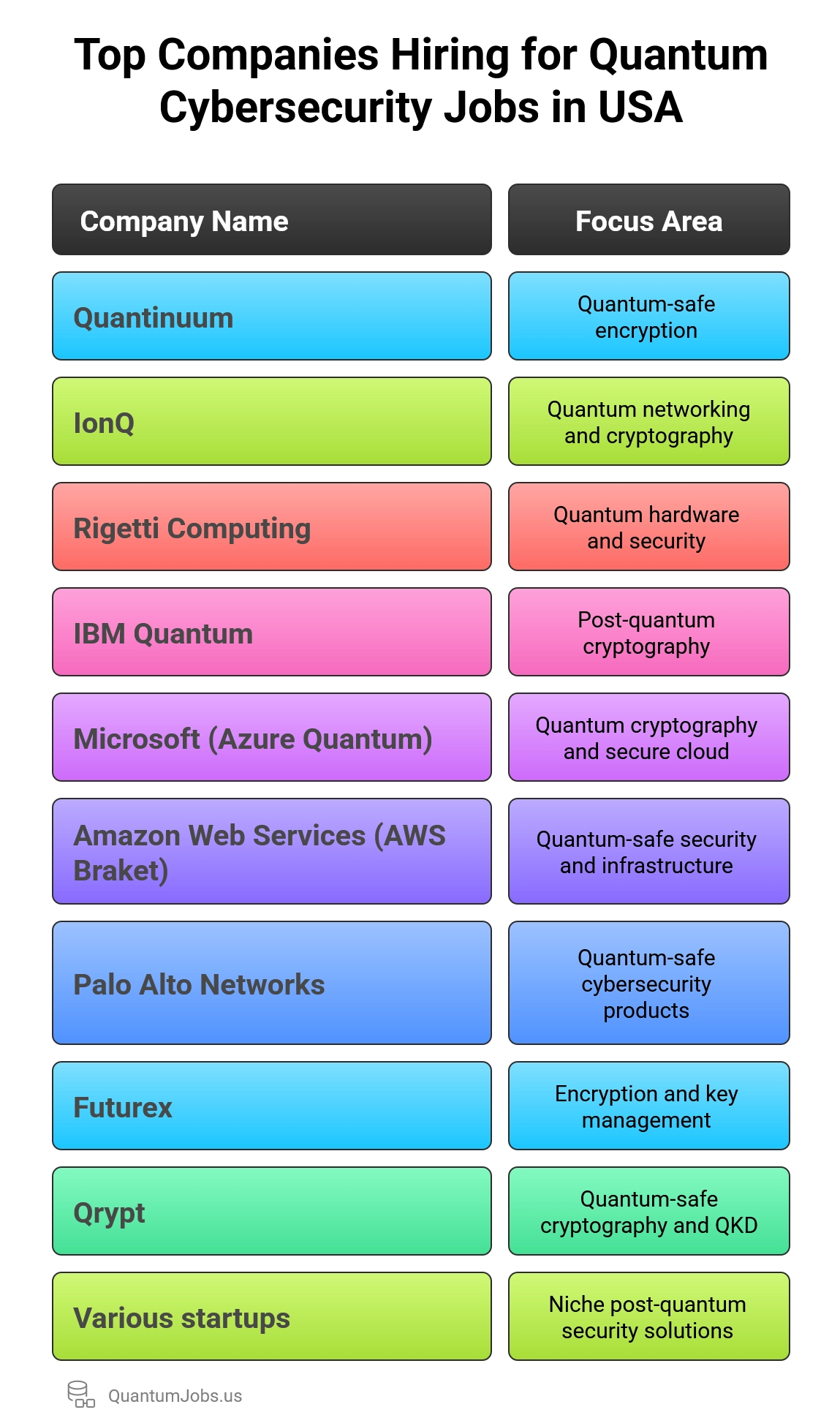
What are Top Companies Hiring for Quantum Cybersecurity Jobs?
The quantum cybersecurity job market spans various sectors, each offering unique opportunities and specializations.
Private Sector Leaders
- IBM Quantum has openings for quantum hardware, software and quantum cybersecurity positions.
- Google Quantum AI focuses on quantum algorithms, error correcting, and quantum-safe cryptography.
- Microsoft Quantum focuses on developing hardware along with Q$ software and Azure Quantum Services with an emphasis on security.
- AWS Braket needs specialists to manage secure quantum cloud operations and implement post-quantum cryptography.
- Startups such as IonQ, Rigetti, D-Wave, and PsiQuantum provide substantial roles with attractive pay.
Government and Defense
- The NSA hires quantum security specialists for national security.
- The Department of Defense provides roles for research and operations in quantum.
- NIST is working on standards for post-quantum cryptography.
- National laboratories such as Los Alamos, Sandia, Oak Ridge, and Lawrence Livermore do quantum research and apply security.
Financial Services
- JPMorgan Chase is primarily focused on quantum research related to cryptography and optimization.
- Goldman Sachs examines potential quantum innovations for financial modeling and security.
- Wells Fargo is forming teams to protect data and transactions from quantum threats.
- Insurance companies implement quantum-safe measures to manage quantum risks.
Consulting Firms
- Deloitte Quantum offers consulting on quantum threats and opportunities.
- Booz Allen Hamilton focuses on quantum consulting for government & national security.
- PwC, Accenture, and others advise clients with combined business and quantum expertise.
What are Salary Expectations and Cybersecurity Career Growth?
Understanding compensation structures helps you negotiate effectively and plan your career trajectory in quantum cybersecurity.
Salary Ranges by Experience Level
- Entry Level Quantum Jobs: $80000 to $120000 for junior software engineers, research assistants and associate security analysts, good starting salaries for new graduates.
- Mid-Level Employees: $120000 to $180000, with some mentorship for juniors and contributions to strategic functions.
- Senior Level Jobs: $180000 to $300000 in major tech firms and financial institutions, focusing on big-picture initiatives.
- Principal and Distinguished Engineer: $300000+ with the potential for bonuses and stock options, requiring proven leadership & impactful contributions to the field.
- Salary Potential: Higher with experience and leadership roles; contributing significant changes in the quantum field.
Suggested Read: Quantum Jobs Salaries
Geographic Variations
Compensation varies by location, and San Francisco offers the highest salaries in quantum computing, averaging $150000. This amount is about 15-20% higher than the national average. The concentration of tech firms and startups in the Bay Area explains the above average salary.
Strong salaries, especially for government and defense-won contracts, can be found in the D.C. and surrounding areas. The steady demand aroused due to national defense would explain the presence of government agencies.
Boston is near MIT, Harvard, and several quantum startups, making it an attractive place to be. The financial services sector in NYC also allows for a very competitive salary for quantum roles. Plenty of quantum positions are available in Seattle due to the tech giant Amazon and other companies along with their really developed tech ecosystem.
There are also many companies that offer remote positions and base their salaries on the national average or the location of the employee. Because of this, people are able to live where the cost of living is low.
Career Advancement Opportunities
As technology jobs grow, they also offer higher pay. In these tracks, one starts at an engineer position, moving on to senior engineer, principal engineer, distinguished engineer, and then finally to a position with a high level of technical authority and influence. Each step in this progression path offers more technical influence and higher wages.
Management roles, on the other hand, are more suited for those with the ambition to oversee a unit or an organization and influence its strategic direction. In this career path, you start as a unit head, then move up to a manager position. From there, you can advance to either a director role or one of the senior executive positions, such as vice president or Chief Technology Officer.
The position of an independent consultant is aimed at someone with a well-established reputation in specific fields; such people can charge highly for their hourly workmanship.
Positions in research and academics in universities or national research centres afford/ provide considerable flexibility in shaping the next generation of professionals as well as the quantum scholars.
Suggested Read: How to start Quantum Career

Future Outlook for Quantum Cybersecurity Jobs
The quantum cybersecurity field stands poised for dramatic growth, driven by technological advancement and increasing organizational awareness of quantum threats.
Industry Predictions
The quantum job market is growing at a rate of 25% yearly, far outshining other tech sectors. The growth reflects both advancements in quantum computing and increasing awareness of the “harvest now, decrypt later” threat.
Government investments, like those from the National Quantum Initiative, will keep creating jobs. Recently, lawmakers set aside billions for quantum research, development, and workforce training. This will create a sustained demand for quantum employees.
The private sector is moving towards using quantum-safe solutions. This shift is driven by the NIST post-quantum standards; which are now required for government contractors. These standards are also recommended for any organization that handles sensitive data. This regulation increases the demand for quantum security expertise.
The fusion of artificial intelligence with quantum tech will generate new roles that will require knowledge of both. Quantum machine learning focused on cybersecurity is one of the most promising.
Emerging Roles
- Quantum-classical hybrid security architects: Design systems combining classical and quantum computing to maintain security during the transition.
- Quantum supply chain security experts: Ensure integrity of quantum hardware and software across development, manufacturing & deployment;
- Quantum AI security specialists: Protect AI systems from quantum attacks and leverage quantum-enhanced AI for threat detection.
- Quantum cloud security engineers: Secure quantum resources on cloud platforms, handling multi-tenant access and data protection.
Preparing for the Future
Stay updated on NIST post-quantum cryptography standards as they evolve from draft to finalized implementations. NIST standards will help guide developers design new cryptography algorithms or protocols.
Monitor quantum computing advancement milestones, including error correction improvements, qubit count increases, and algorithm breakthroughs. These developments directly impact security timelines and priorities.
Quantum professionals should also build skills in adjacent disciplines, especially in AI, blockchain, or cloud computing. Most quantum professionals will be in high demand.
Ongoing professional development is important. This includes taking courses, earning certifications, attending conferences, and working on practical projects. The industry is innovating rapidly and is far removed from the formal education you might have completed in the last few years.
Suggested Read: Quantum Career Roadmap
Conclusion
Quantum cybersecurity is one of the most exciting and impactful career opportunities available today. Quantum computers are rapidly advancing, and the professionals who can defend our digital systems against quantum threats are becoming increasingly indispensable.
In the guide, we cover ten quantum cybersecurity roles. These roles span a variety of fields and can serve as entry points to quantum cybersecurity. Whether you are one of the physics PhDs who has published cryptography research, a cybersecurity analyst looking to expand your skillset toward quantum technologies, or a computer science major graduating early and looking for a job, there is a role for you. Each role plays an essential part in our mission to secure the digital world of the future.
It is a challenging and meaningful job. It is also well-paid, and you will be working on impactful problems. You will be working on cutting-edge problems that are only five years old, and you will be working on solving problems that will not exist for another ten years.
You have a positive attitude, and you have the right tools available for learning about quantum education. For self-directed learning, there are many free resources, guides, and open-source quantum. It is available, and the only thing standing in your way is a lack of will, strong curiosity, and good programming.
Start your quantum cybersecurity journey today. Take an online quantum computing course, experiment with Qiskit or Cirq. Every expert in this field started as a beginner, and the field's rapid growth means opportunities exist for motivated learners at all levels.
Suggested Read:
- Qualification required for Quantum Jobs
- Are Quantum Jobs in high Demand
- Top US Companies Offering Quantum Jobs
Editorial Team
Author: Quantum Jobs USA Editorial Team
This resource is managed by the Quantum Jobs USA team, a specialized group of technical recruiters and industry analysts focused on the American and international quantum labor market. Every listing and career guide is manually reviewed for accuracy and technical relevance to ensure high-quality opportunities for the global quantum community.
FAQs on Quantum Cybersecurity Jobs USA
Do I need a PhD to get a quantum cybersecurity job in USA?
No, not for all roles. Jobs like security analyst or software engineer can be obtained with a bachelor or master degree. Focus on skills through projects and certifications to be competitive.
What qualifications do I need to work in quantum cybersecurity?
A bachelor degree in computer science, physics, mathematics, or cybersecurity is often required. Advanced roles may require a master's or PhD. Key skills include strong math, programming and a grasp of cybersecurity or quantum mechanics. Relevant certifications can enhance your profile.
How much can I earn in quantum cybersecurity USA?
Salaries range from $80000 - $120000 for entry-level positions to over $300000 for senior roles at top companies. Mid-level professionals typically earn $120000 - $180000. Location significantly impacts pay, such as San Francisco, Washington D.C., and New York offer 15-30% premiums over national averages. Total compensation often includes bonuses, stock options and benefits adding 20-40% to base salary.
Where are most quantum cybersecurity jobs located in the USA?
Major hubs include the San Francisco Bay Area, Washington D.C., New York, Boston, Seattle and Austin. Remote work is increasingly available, broadening job opportunities.
What programming languages should I learn for quantum cybersecurity?
Learn Python for frameworks like Qiskit and Cirq. C++ is useful for high-performance tasks. Q# is essential for quantum-specific applications. Familiarity with Java and security frameworks is beneficial.


.svg)